Knossos Palace: The Complete Visitor Guide (2026)
Knossos is the largest Minoan palace on Crete and the most important archaeological site in Greece after the Athens Acropolis. Here is everything you need to know before you visit.
Quick Facts
- Location: 5 km south of Heraklion city centre
- Opening hours: Daily 08:00-20:00 (April-October); 08:00-15:00 (November-March)
- Entry fee: 15 euros; combined ticket with Heraklion Archaeological Museum: 20 euros (buy online to skip queues)
- Time needed: 1.5 - 2.5 hours (more with a guide)
- Best time to visit: Early morning (08:00-09:30) or after 17:00 to avoid peak heat and tour groups
Getting There
From Heraklion city centre, take Bus Line 2 from the KTEL station near Plateia Eleftherias - journey 20 minutes, every 15-20 min, fare 1.70 euros. By taxi: 10-12 euros. By car: 15 min, park in the official paid car park (2 euros/hour).
What You Will See
The West Wing: Ceremonial Core
The west side of the palace contains the most important ceremonial spaces:
- The Throne Room (reconstructed by Arthur Evans, c. 1900 BC): The oldest throne in Europe, flanked by painted griffins. The alabaster seat is original; the frescoes are painted reproductions of the originals (now in the Heraklion Archaeological Museum).
- The Propylaea (South Entrance): Monumental gateway leading to the piano nobile (upper floor) and the main ceremonial rooms.
- The West Magazines: Long storerooms that held giant pithari (storage jars) for olive oil, wine and grain. Some original jars remain in situ.
The East Wing: Royal Apartments
The east wing descends five floors into the hillside via a grand staircase:
- The Grand Staircase: Five flights of the original limestone staircase survive. One of the most impressive Minoan engineering achievements.
- The Hall of the Double Axes: The principal royal room, so named for the double-axe (labrys) symbols carved into the walls.
- The Queen's Megaron: The queen's private apartments, decorated with a famous dolphin fresco (reproduced; original in the museum).
The Central Court
The great open courtyard (54 m x 28 m) at the heart of the palace. Bull-leaping - the famous Minoan sport depicted in frescoes - is believed to have taken place here. The court was open to the sky; the multi-storey rooms around it were lit by light wells.
The Bull's Head Rhyton & Theatrical Area
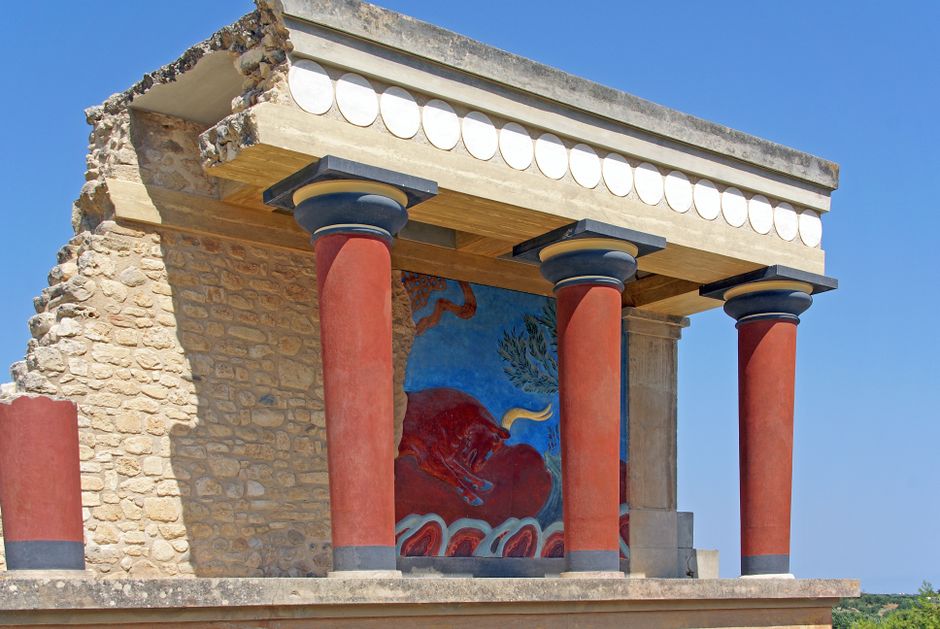
North of the palace, a partially reconstructed theatrical area (with stepped viewing platforms) and the north entrance with its iconic Charging Bull fresco reproduction.
A Brief History
3000-1900 BC (Pre-Palace Period): Settlement on the Kephala hill; simple structures and early Minoan culture.
1900-1700 BC (Old Palace / Protopalatial Period): First large palace built. Destroyed by earthquake c. 1700 BC.
1700-1450 BC (New Palace / Neopalatial Period): The palace we see today - rebuilt and expanded after the earthquake. This is the period of peak Minoan power: a palace of 1,300+ rooms over five floors, with running water, flush toilets, light wells and advanced fresco painting. Population of Knossos: possibly 100,000 - making it one of the largest Bronze Age cities in the world.
1450 BC: Catastrophic destruction of almost all Minoan palaces across Crete - most likely connected to the Thera (Santorini) volcanic eruption. Knossos alone survived, possibly under Mycenaean Greek control.
1375 BC: Final destruction of Knossos palace. Never rebuilt.
1 AD: The city of Knossos (Greek and Roman) continued near the site.
1878: Discovery by Minos Kalokairinos.
1900-1935: Sir Arthur Evans purchases and excavates the site. His controversial reconstructions (using reinforced concrete and modern paint) remain in place today.
Arthur Evans and the Minotaur
Arthur Evans gave the palace its name (from the legend of King Minos and the Labyrinth). Whether the labyrinth myth originated here is debated - but the multi-level, maze-like palace with its bull-leaping frescoes clearly inspired the story of Theseus and the Minotaur. Evans also coined the term "Minoan" after the legendary king.
Tips for Your Visit
Hire a licensed guide. The site is complex and the information boards alone cannot convey the full picture. Licensed guides stand near the entrance (15-20 euros per person for a 1h guided tour). Alternatively, download an audio guide app before arrival.
Visit the museum before or after. The Heraklion Archaeological Museum (10 min by taxi, 20 min by bus) holds the originals of all the frescoes, the Snake Goddesses, the Phaistos Disc and the Bull-Leaping fresco. The combined ticket (20 euros) is excellent value.
Wear comfortable shoes. The site is hilly and partly paved with the original Minoan limestone, which is slippery. No high heels.
Beat the heat. In July-August the site is exposed and temperatures reach 35-40C by midday. Come at 08:00 with a hat, sunscreen and a full water bottle.
Photography: Freely allowed throughout. The best photo positions are from the upper terrace looking down into the central court, and from the south side looking north at the reconstructed facade.
Nearby Attractions
- Heraklion Archaeological Museum (5 km north): Essential companion to the palace. Allow 2 hours.
- Villa of Archanes (14 km south): A Minoan country villa with good Mycenaean-period finds.
- Archanes village: Excellent wine village, 15 min south of Knossos. Good Sunday market.
- Heraklion city centre: Koules fortress, 1866 market street, Venetian walls. 20 min drive.
Frequently Asked Questions
Can I enter Knossos without a ticket booked in advance? Yes - walk-up entry is available but queues can be 30-45 min long in peak season (July-August). Buy online at culture.gr to enter immediately.
Is Knossos suitable for children? Very suitable. Children aged 8-14 in particular are fascinated by the palace; the mythology makes it accessible. Under-18 EU citizens enter free. The site is mostly flat; the grand staircase is the most challenging section.
How is Knossos different from Phaistos? Knossos is larger, better-known and more heavily restored (Evans). Phaistos (60 km southwest) is smaller, less crowded and has seen minimal reconstruction - showing the original ruins without interpretation. Phaistos is more authentically "ruin"; Knossos is more visually communicative.
Are Evans reconstructions authentic? Controversial. Evans used early 20th-century concrete and painted reconstructions based on fresco fragments and partial foundations. Many archaeologists today consider his reconstructions partially speculative. Modern Minoan archaeology is more conservative. The museum context is essential to understand what is original vs. reconstructed.