Samaria Gorge Hiking Guide 2026: Opening Dates, Route & Logistics
The Samaria Gorge is Europe's longest gorge at 18 km, and the most iconic hike in Greece. Every year 300,000+ hikers walk the descent from the Omalos Plateau to the Libyan Sea. Here is how to do it properly in 2026.
2026 Opening & Closure Status
- Typical open season: 1 May – 31 October (weather dependent).
- Winter: Closed for flood and rockfall risk — do not attempt the full gorge off-season.
- May openings: Early May can still see delayed openings after wet winters. Before you travel, confirm the day's status with the Samaria National Park / Forest Service or Chania tourism desk — especially if searching whether Samaria is open or closed on a specific May date.
- Entry cut-off: You must enter at Xyloskalo by 16:00 to reach Agia Roumeli before evening boats.
Key Facts
- Length: 18 km (top to bottom, descent only)
- Total ascent/descent: 1,250 m descending (you walk downhill the whole way)
- Walking time: 4-7 hours (average 5.5 hours; fast hikers 4h, slow or elderly 6-7h)
- Difficulty: Moderate. Long, but no technical climbing. Knee strain on the steep upper section.
- Season: Open 1 May to 31 October. Closed in winter due to flooding risk.
- Entry fee: 5 euros (collected at the Xyloskalo entrance gate)
- Best month: May, June or September-October (fewer people, cooler)
The Route
Section 1: Xyloskalo to the 7 km Mark (Steep Descent)
The gorge starts at the Omalos Plateau at 1,227 m altitude. The first 3 km is a steep wooden-railed staircase (xyloskalo = wooden stair) descending 600 m. This is the most physically demanding part. Take it slowly; do not rush downhill - knee injuries here are common.
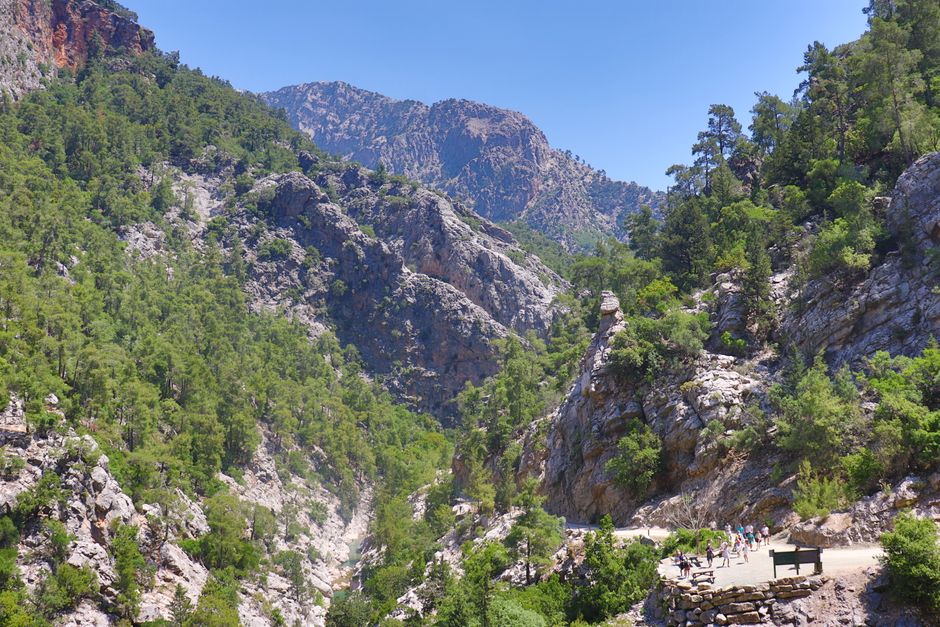
After the staircase, the path levels into a wide forested valley with towering rock walls (up to 600 m high at the narrowest point). The river runs alongside for much of the route; in May-early June it is full and fast. By September it is often dry.
Key stop at 4 km: the abandoned village of Samaria. The old chapel of Osios Christos (12th century) is beautifully preserved. A staff checkpoint and water tap here.
Section 2: The Iron Gates (Km 11-12)
The most dramatic and photographed section: the gorge narrows to just 3-4 m wide with walls rising to 300 m on either side. You walk through ankle-deep water (in May-June) or on dry stones. This is the geological centrepiece of the walk.
Section 3: Agia Roumeli (Km 12-18)
After the Iron Gates, the gorge widens into the coastal valley. The final 6 km to Agia Roumeli is a flat, gravelled path through olive groves. The village of Agia Roumeli sits directly on the Libyan Sea coast. A small beach, tavernas and the ferry departure point are all here.
Getting There and Back
Getting to Xyloskalo (start):
- KTEL bus from Chania: Departs Chania bus station daily at 06:15, 07:30 and 08:30 (May-October). Journey to Omalos: 1h 20m. Fare: 7 euros one way. This is the easiest option.
- By car: Drive 42 km south from Chania to Omalos (1h). Leave your car at Omalos - the gorge is one-way only (you cannot return to Omalos from Agia Roumeli by land).
- Organised tours: Day tours from Chania (and many hotels) include bus transfer to Omalos, gorge permit and afternoon bus back from Chora Sfakion. Around 25-35 euros.
Getting back from Agia Roumeli: Agia Roumeli is accessible only by boat. You cannot walk or drive out.
- Boat to Chora Sfakion: ANENDYK ferries run from Agia Roumeli to Chora Sfakion (45 min, 14 euros). Departs at approximately 15:30 and 18:00 (check current schedule at anendyk.gr).
- Boat to Paleochora: Also served by ANENDYK from Agia Roumeli.
- Bus from Chora Sfakion back to Chania: KTEL buses meet the ferries and run back to Chania (1h 30m, 7.50 euros).
- Car at Chora Sfakion: If you drove to Chania and parked, take a taxi from Chora Sfakion back to Omalos (around 50-60 euros).
Complete day logistics (recommended):
- 06:15 KTEL bus Chania → Omalos
- 07:45 Enter gorge at Xyloskalo
- ~13:30 Arrive Agia Roumeli; swim and eat
- 15:30 Ferry to Chora Sfakion
- 16:30 KTEL bus back to Chania
- ~18:00 Back in Chania
What to Pack
- Shoes: Trail running shoes or hiking boots with ankle support. No flip-flops or sandals; the rocky path will punish them.
- Water: Minimum 2 litres. Refillable at taps inside the gorge (safe to drink).
- Food: Bring a packed lunch or snacks. The only food in the gorge is at the Samaria village checkpoint (minimal) and at Agia Roumeli at the end.
- Sun protection: Hat, sunscreen, sunglasses. The lower valley is exposed.
- Trekking poles: Strongly recommended for the steep upper section. Reduces knee strain significantly.
- Light layers: Omalos plateau is 1,200 m - cool even in July. The gorge itself warms rapidly.
- Cash: For entry fee, ferries and food.
Difficulty and Fitness
The Samaria Gorge is NOT a technical hike. There are no ropes, no scrambling, no climbing. It is simply long and rocky. Anyone in reasonable health who can walk 18 km can complete it. The upper staircase is steep but has handrails. The main challenge is the length and the uneven rocky surface.
Children: suitable from age 8-9 upward with some hiking experience. Allow extra time. Elderly: plenty of visitors in their 60s-70s complete the gorge; allow 6-7 hours.
Rules and Regulations
- Entry times: 07:00-16:00 (you must enter before 16:00 to reach Agia Roumeli before ferry closes)
- No camping in the gorge
- No fires
- Do not pick plants or disturb wildlife (Egyptian vultures and wild Cretan ibex - Kri-Kri - live here)
- Dogs allowed on leash
Wildlife
The Samaria Gorge National Park protects the Cretan ibex (Kri-Kri - a wild goat unique to Crete). Most visible in the upper gorge in early morning. Egyptian vultures and peregrine falcons circle the cliffs. The endemic Cretan wild cat (ferocious, rarely seen) also inhabits the gorge.
Alternatives to the Full Gorge
If you cannot commit to the full 18 km, there are two alternatives:
The "Lazy Walk" (bottom section from Agia Roumeli): Take the ferry TO Agia Roumeli, walk 2-3 km into the gorge to the Iron Gates and return. No permit needed for the bottom section outside the park boundary. See the most spectacular scenery without the full hike. Ferries from Chora Sfakion or Paleochora.
Imbros Gorge (an excellent alternative): 8 km, 3-4 hours, less crowded than Samaria, equally impressive in places. Starts from Imbros village south of Chania. Park at the top; shuttle bus from Chora Sfakion back.
Frequently Asked Questions
Can I do Samaria as a day trip from Heraklion? Yes but long: KTEL bus Heraklion to Chania (1h 30m), then 06:15 bus to Omalos. Total travel time each way is 3+ hours. Better to stay in Chania the night before.
What if I cannot finish the gorge? Emergency exits exist at km 7 (Samaria village) and km 12 (after the Iron Gates). Rangers patrol the gorge during opening hours and will assist hikers in difficulty. The park closes at sunset; if you have not exited, rangers will find you.
Is the gorge crowded? Peak months (July-August) see 1,500-3,000 hikers per day; the upper staircase can queue. Starting at 06:15 (first bus) puts you ahead of most groups. May, June and September are dramatically less crowded.
Can I do the gorge in the reverse direction (bottom to top)? No - the gorge is officially one-way downhill only. Bottom-up travel is prohibited by the park authority.